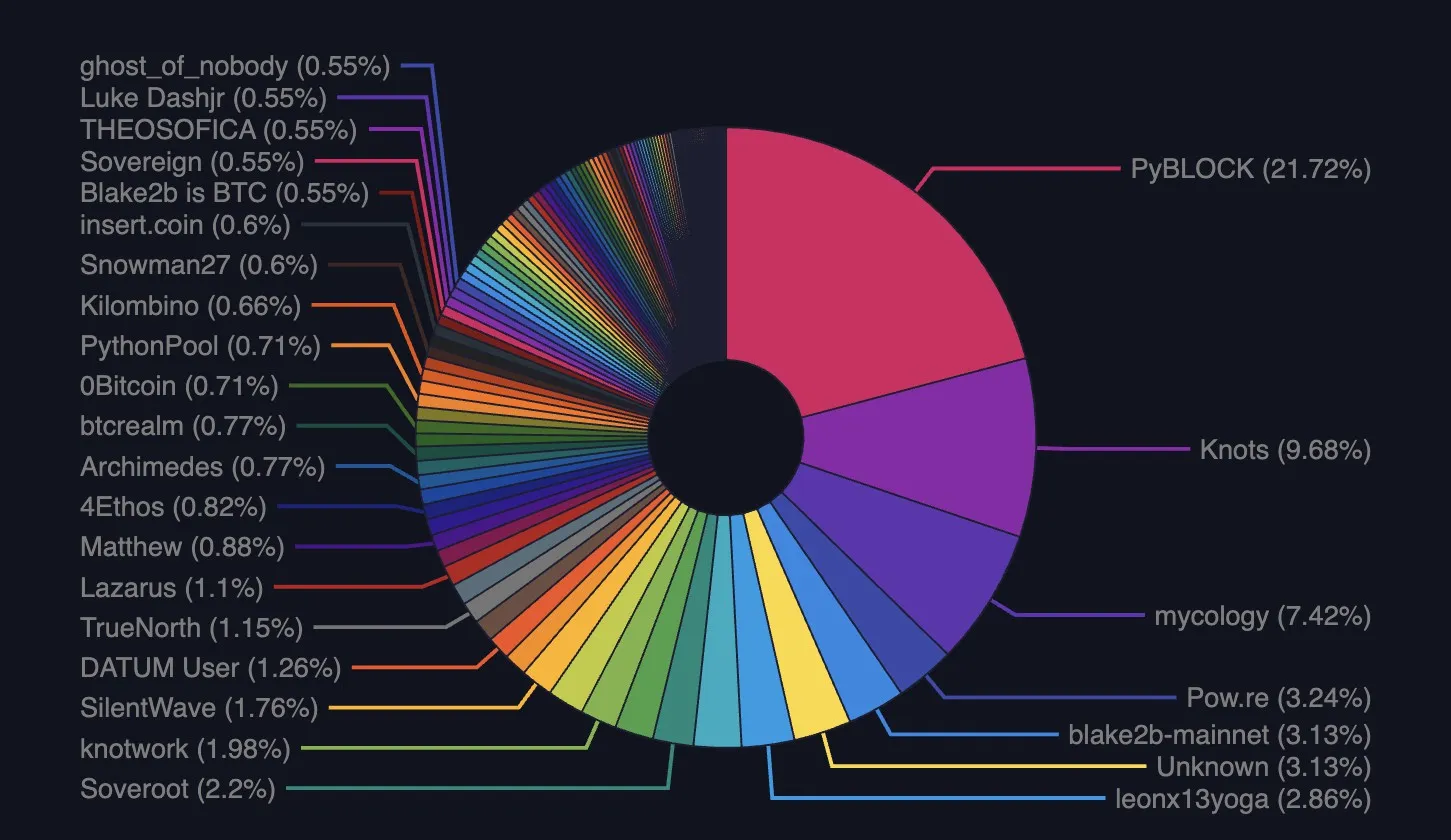
mempool.guide, 1 September, 13:53 UTC. Every slice is a coinbase tag.
Someone is mining this chain under the name Gresham’s Law. Someone else as ghost_of_nobody, someone as Lazarus, someone as Blake2b is BTC. There is a Goodfellas, a Soveroot, a THEOSOFICA, a 0Bitcoin. The third-largest slice on the whole chart is called mycology. One tag reads Luke Dashjr, which anyone can type. One reads PLACEHOLDER, because whoever runs it never changed the default in their DATUM config, and their blocks are no less valid for it.
What the chart counts
A coinbase tag is free text a miner writes into the one transaction that creates new coins. Satoshi used the space for a newspaper headline. This chain’s first block had to; after that the field went back to being whatever the miner wants, which is how ours ended up reading 8-30 NYPost Deride And ConquerBLAKE2bMiner.com. An explorer names a block’s miner by matching that text against a list someone maintains by hand. mempool.guide’s list is long, which is why its chart can show 128 names where mempool.space would show a handful, and anything not on the list lands in Unknown. Our three blocks are in that slice.
So “128 pools” means 128 distinct strings that matched, over the last seven days, which on this chain means since activation on 30 August. Not 128 companies. One operator can run several tags; one tag, PyBLOCK, is itself hundreds of renters pointed at one pool. With that said, here is the week, read from both explorers’ APIs at 13:52 UTC:
| Last 7 days | BLAKE2b chain | SHA-256d chain |
|---|---|---|
| Blocks | 1,818 | 1,032 |
| Names on the chart | 128 | 18 |
| Largest | PyBLOCK, 21.7% | Foundry USA, 25.4% |
| Top three together | 38.8% | 58.2% |
| Names with exactly one block | 19 | 0 |
Sources: mempool.guide and mempool.space, the same endpoint on each.
The right-hand column is the chain with nearly a zettahash behind it. The left-hand column is about 2 PH/s, a couple of millionths of that, which is the other thing the chart is telling you: a block here is cheap enough that a $250 box in a living room gets a slice. This is decentralized the way a village is decentralized. Whether it stays that way as hashrate arrives is the question the next few retargets will answer, and we will keep posting the chart.
Which law the names are betting on
Gresham’s law is usually quoted as “bad money drives out good,” and usually quoted wrong. The full version has a condition: when two monies are forced to trade at the same face value, people spend the one they value less and keep the one they value more, so the bad money is what circulates and the good money disappears into drawers. Take away the forced rate and let the two float against each other, and the textbook prediction reverses: people refuse the worse money and the better one wins the market. Economists call that the reverse of Gresham, or Thiers’ law.
Both coins have the same supply schedule, the same 21 million. What differs is who gets to say no to a block: on this chain the rules the nodes chose held, and the miners who would not follow them left. Whether that makes it the better money is exactly what nobody can settle from a chart. What the chart does show is the first half of Gresham playing out by construction: 1,818 blocks of new coin, and until this week not one wallet that could spend any of it. Everything mined here is being kept, because there was nothing else to do with it. The miner who tagged their blocks Gresham’s Law knew what they were saying.
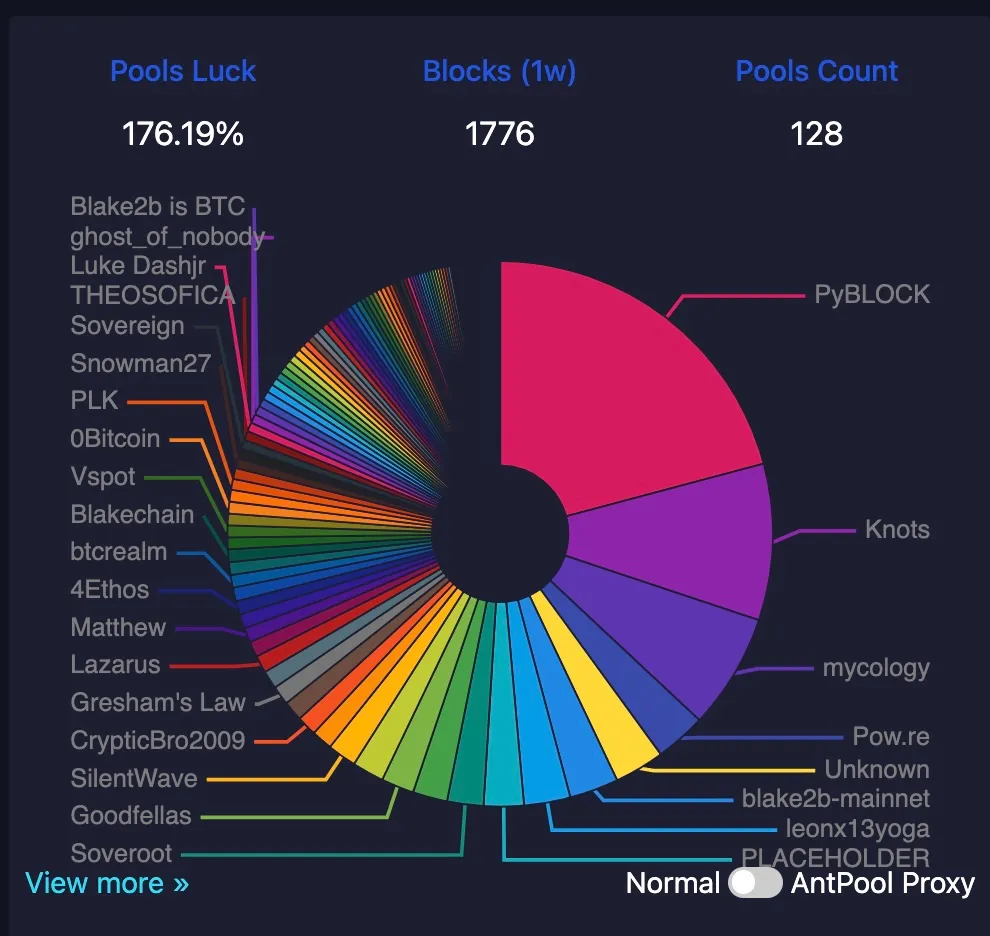
The chart at 13:06 UTC. By 13:53 the tail had grown enough that Gresham’s Law lost its label; the API still lists it.
Our position, dated 1 September so it can age in public the way we let Chris Guida’s 4 August prediction age on the front page: we expect the coin that is harder to change to be the one people keep, and the one people keep to be the one that eventually gets priced. The other chain has the hashpower, the exchanges, the balance sheets and the ticker symbol, and every one of those is a real reason it could go the other way. We are not pricing anything and there is no market we would point you at. We run a node and a box, and we hold what the box found.
Also today
The first difficulty retarget came at block 963,648, mined at 16:33 UTC while this post was being written: difficulty fell from 30,393,776 to 17,842,860, down 41.3%, for the reason in the last post’s correction. The projection there was 17.8 million; the chain delivered it to within 250. At the current hashrate that is a block every half minute or so until 965,664, the first retarget measured entirely under BLAKE2b, which is where the village question above gets its first real answer.
If you want a slice of that chart, the guides are the node and the box. Pick a better name than we did.